tealemonleft_swallowright_swallowleft_camusright_camusleft_buildingright_buildingOlga Volchkova

Plants & Science

I'm representing plants that helped us in our achievments
in engineering and dicoveries in the natural sciences.
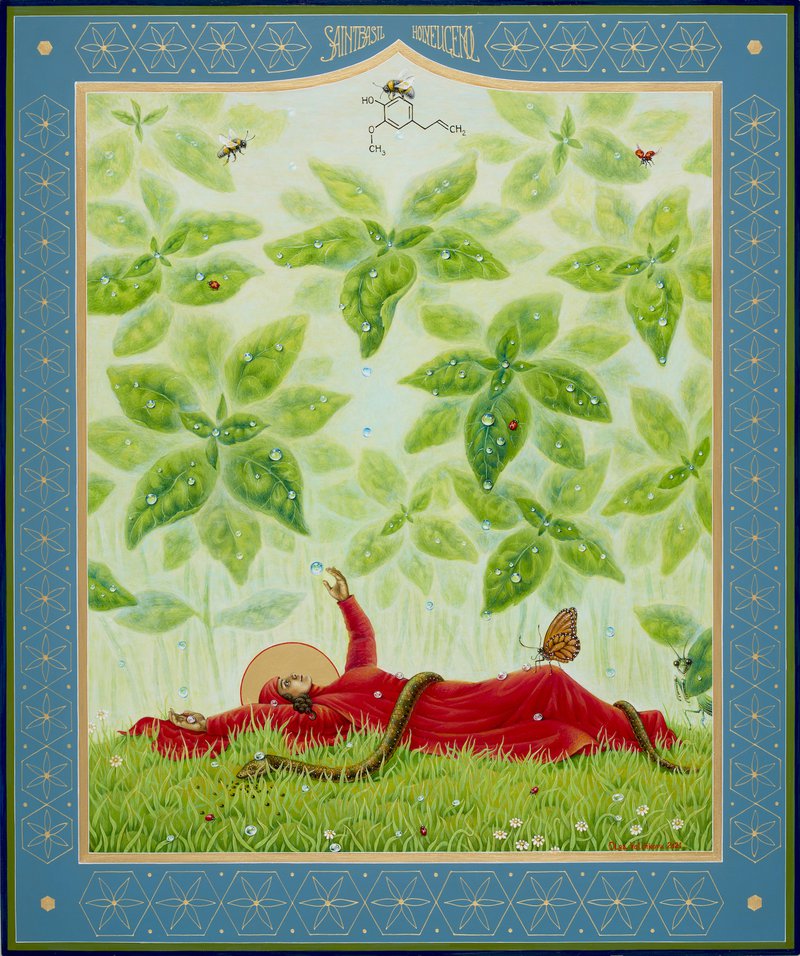
Saint Basil
Saint Basil
2021
20" x 24"
wood & acrylic
(Exhibited in 2022 at the Schneider Museum of Art)
(in private collection, Oregon)

One of the largest families of local anesthetics came from the discovery of eugenol in many herbs and spices, including cloves and basil. I imagine a forest of basil, under which this saint rests, catching drops of Holy Eugenol, somewhere in medieval Persia, which may be where the most popular strain of basil originated. I studied orthodox saints and I’ve noticed that none of them lie down, unless they are dead. I guess it’s not polite for them to relax in front of their god. This is unnecessarily strict, and dated. In Eugene, I met Naeemeh. She is from Iran, and she pointed out an old story of a Persian king who saved a large snake. The snake was so grateful, it spit up seeds of the royal basil plant, as a gift.
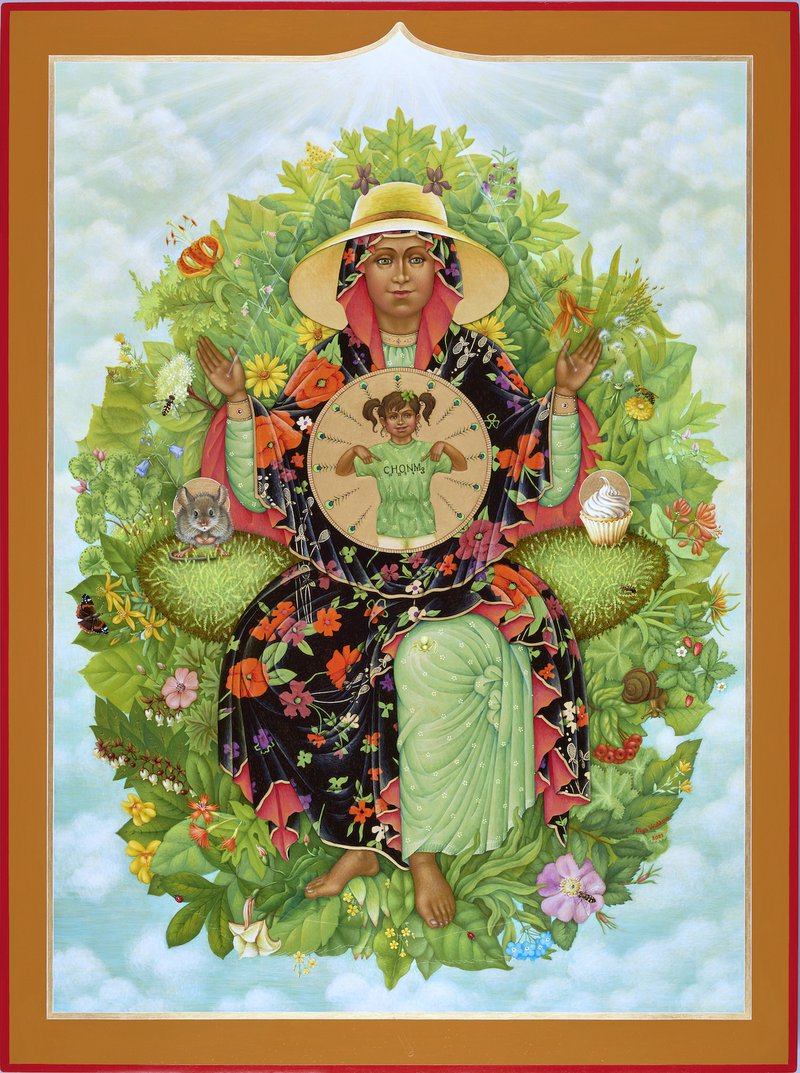
Saint Chloroplast
Saint Chloroplast
2021
30" x 40"
wood & acrylic
(Exhibited in 2022 at the Schneider Museum of Art)
(in private collection, Oregon)

Nature is a magician. It produces constant gifts for us. Those gifts are often invisible, but completely essential for most life on earth. Every little leaf around us is an advanced machine that eats carbon, sunlight, and water to produce sugar and oxygen. It truly deserves honor and respect. No human engineering can recreate that machine. In this painting, sugar is represented by a muffin. Carbon is represented by a mouse -- so many of these little fellows died so we could understand the process. In the center is the magic green molecule, chlorophyll, which absorbs just the right wavelengths of sunlight.
Saint Pea
Saint Pea
2020
20" x 24"
wood & acrylic
(Exhibited in 2022 at the Schneider Museum of Art)

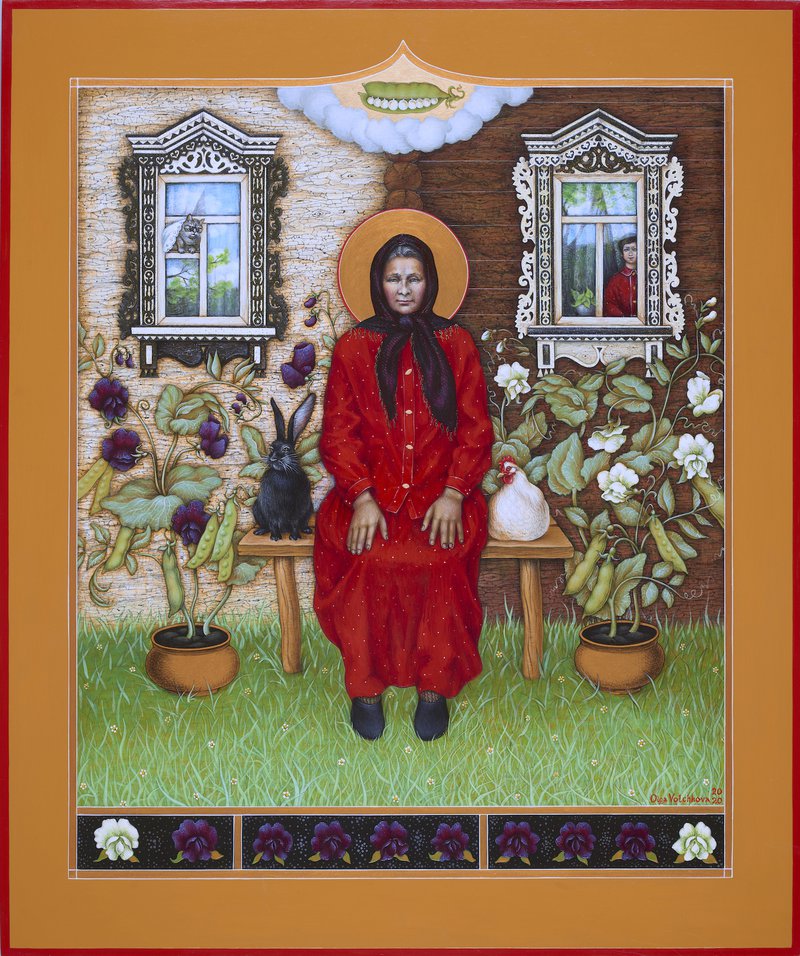
Observations about pea hybridization by village farmers, who were almost always women, led Gregor Mendel, who grew up in such a village, to conduct the first modern genetic research. Rigorous experiments allowed Mendel to build a mathematical model of inherited characteristics. If you cross-pollinate purple and white peas, the recessive white gene is expressed only after skipping one generation. That would explain why I look like my grandmother. And Saint Pea smiles down upon us all.
Sister Maize
Sister Maize
2022
20" x 24"
wood & acrylic
(Exhibited in 2022 at the Schneider Museum of Art)
(in private collection, Oregon)
Sister Bean
Sister Bean
2022
20" x 24"
wood & acrylic
(Exhibited in 2022 at the Schneider Museum of Art)
(in private collection, Oregon)

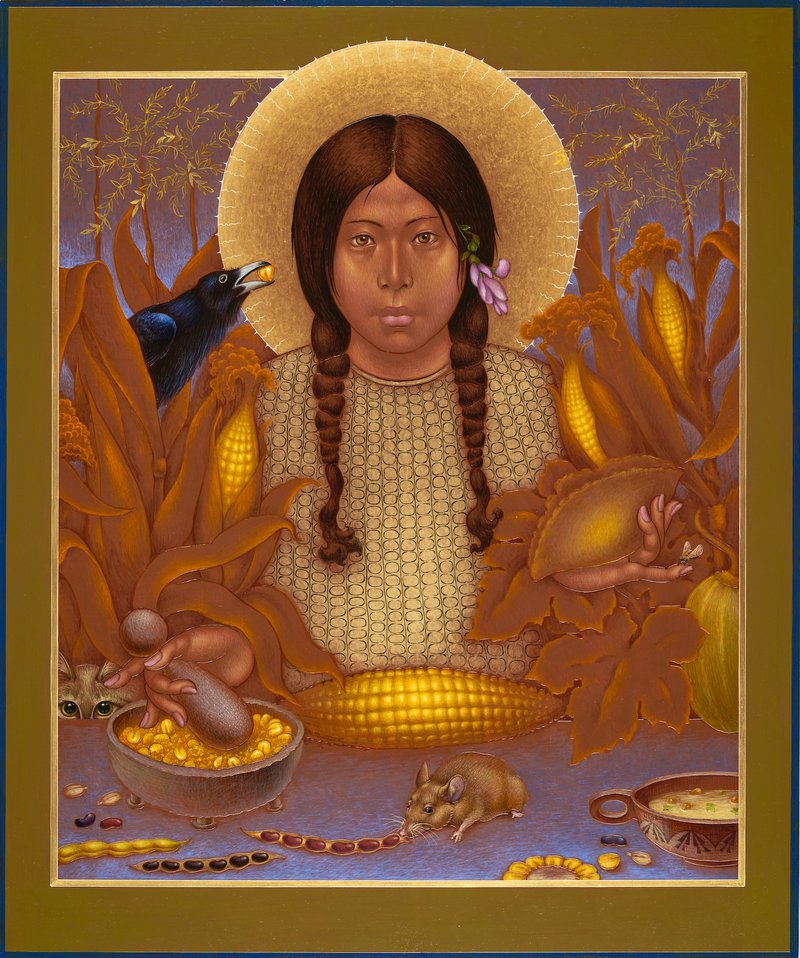
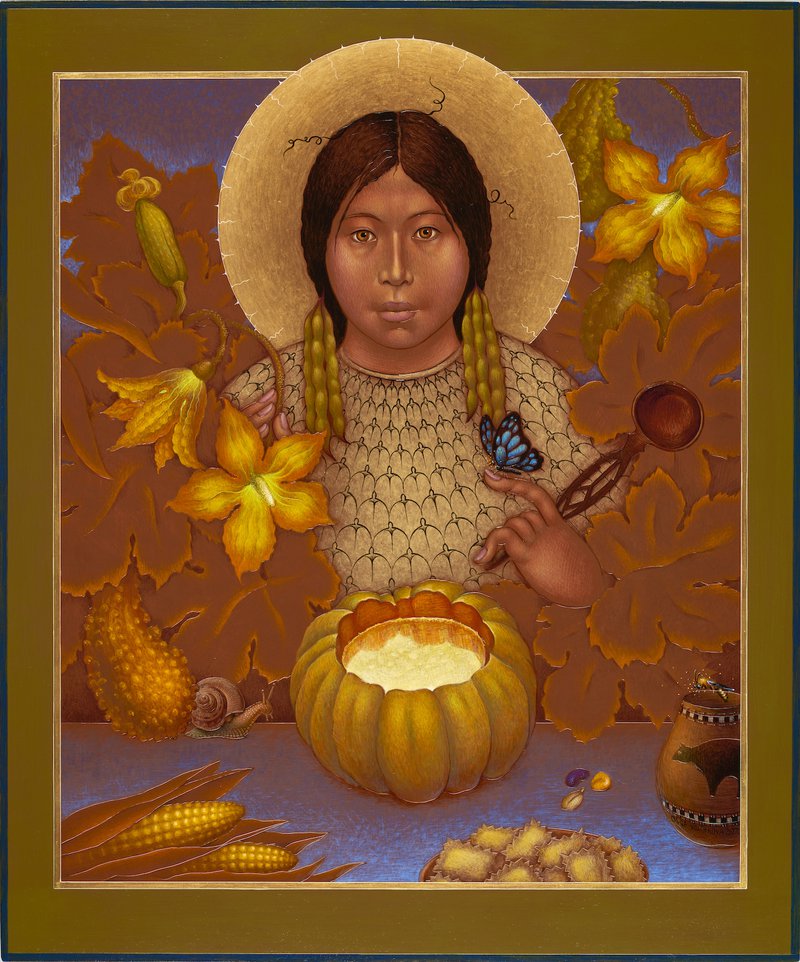
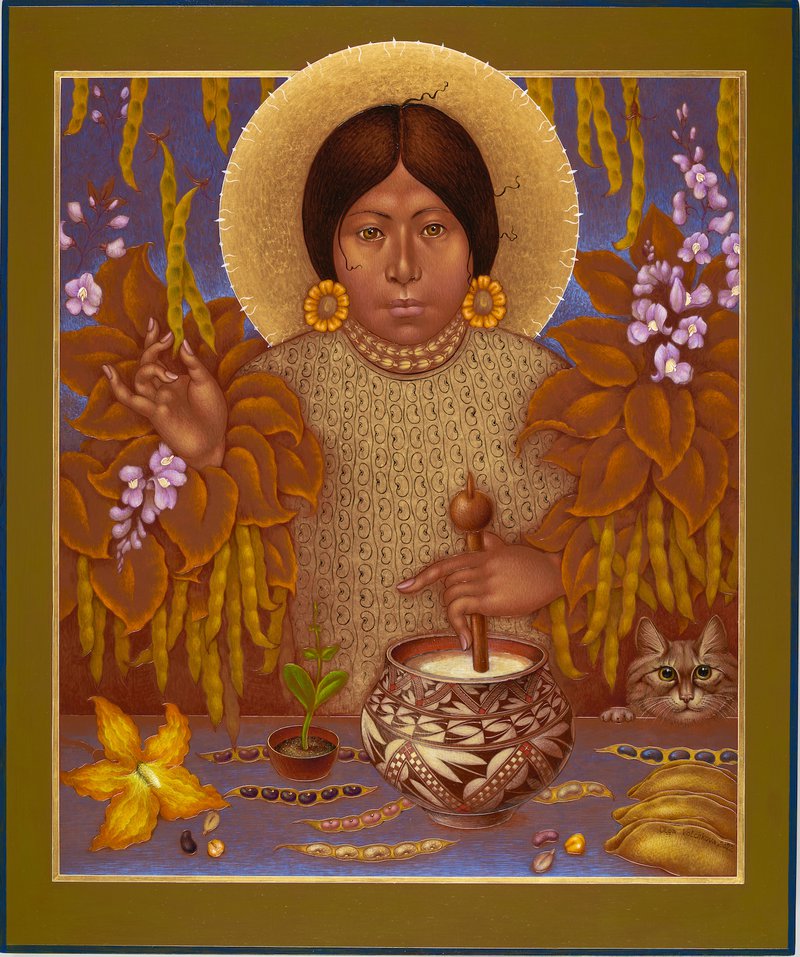
These paintings were inspired by the book Braiding Sweetgrass by Robin Wall Kimmerer. The Three Sisters - Maize, Squash, and Bean - provide an example of a symbiotic relationship between nature and agriculture. They convey an ancient practice that’s much more effective than today’s industrialized monoculture, which exhausts the land and destroys the natural world. Native people planted these three plants near forest edges, or inside of forest openings, where soil is rich and sunlight plentiful. The sisters help each other, like sisters do. Sister Bean provides nitrogen to the soil, Sister Squash keeps slugs and snails away with her spikiness, and Sister Corn provides a scaffold for Sister Bean to climb. If you eat them together - your diet is properly balanced with fiber, proteins, vitamins, and tasty flavors. The Sisters are gifted, smart and powerful.
Sister Squash
Sister Squash
2022
20" x 24"
wood & acrylic
(Exhibited in 2022 at the Schneider Museum of Art)
(in private collection, Oregon)
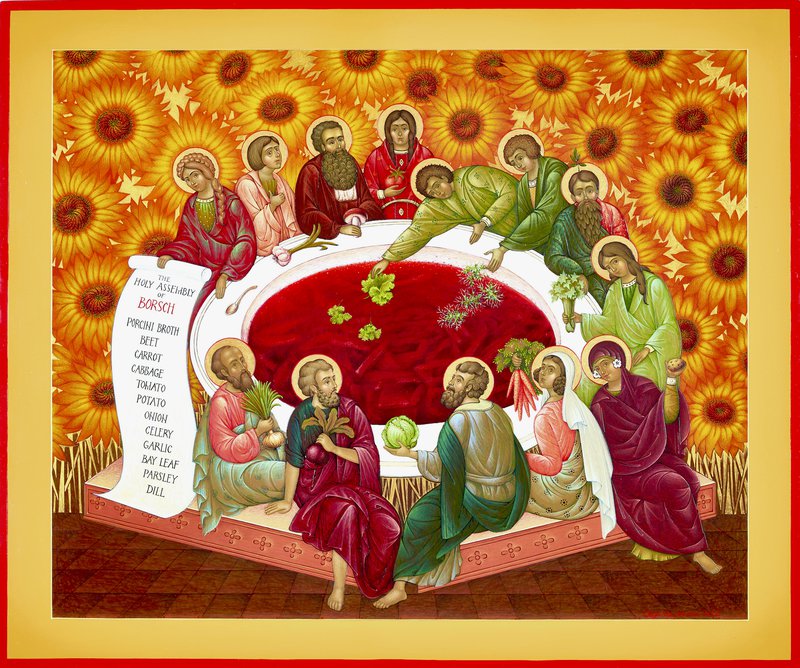
The Holy Assembly of Borsch
2022
20" x 24"
wood & acrylic
(in private collection, Oregon)

Autumn is harvest time.
After the hard work is over, it’s time to enjoy the roots of our labor.
What better way to appeciate this bounty than as a community?
Everyone brings something to the table.
That’s how an amazing and unique dish such as borsch is created.
Twelve friends combine their efforts to create this
colorful, festive deliciousness.
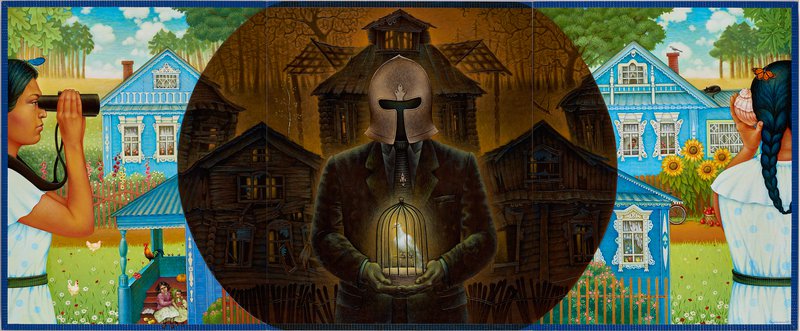
The Resurrection of Life
2021
72" x 30" (triptych)
wood & acrylic
(Exhibited in 2022 at the Schneider Museum of Art)

I’m saddened by the continued destruction of ways of living that are in harmony with nature. As a result of this destruction we survive, in a way, but we cannot be fully alive. The people in the center of the destruction seem to live in terrible fantasies within which we are, unfortunately, forced to struggle. But for me, this is a hopeful painting. When we see what is wrong, we can fix the problems, and ressurect our harmonious relationship with nature, again living lives that are fair, stable, beautiful, and complete.
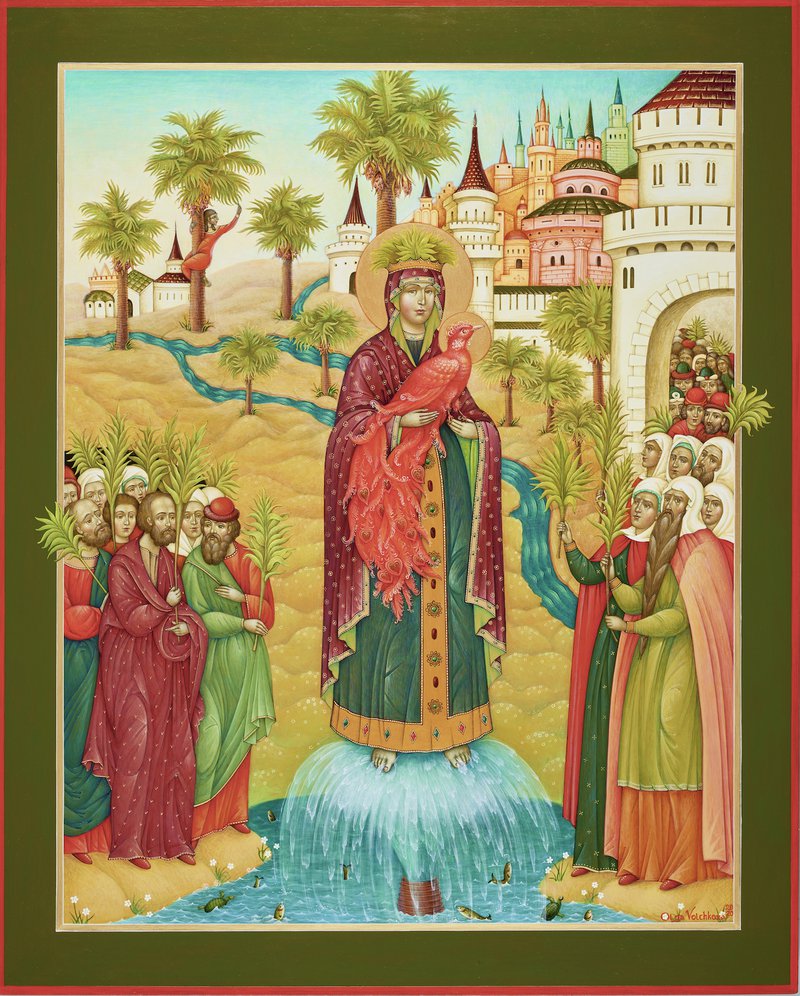
Saint Date Palm
Saint Date Palm
2020
24" x 30"
wood & acrylic
(Exhibited in 2022 at the Schneider Museum of Art)
(in private collection, Oregon)

Phoenix dactylifera - it makes the deserts bloom. It also inspired the creation of the ancient pump - what was later called "Archimedes’ Screw", which pumped water into the famous gardens of Nineveh, which we call the Gardens of Babylon. The Akkadian word for this pump is the same as that for the date palm. The palm trunk forms a helix, which water cascades down in a spiral, so the pump simply rotates the helix in order to raise water.